volver

viernes, 6 de noviembre de 2015

Congreso de la SAM

PRESCRIPCIÓN  DE MEDICAMENTOS POTENCIALMENTE INAPROPIADOS  EN UNA POBLACIÓN DE ADULTOS MAYORES.

Rattagan, María Lucía; López Vicchi Martín; Parisi, Virginia; Persi, Gabriel; Da Prat de Magalhaes, Gustavo; Lisei, Dario; Bres Bullrich, María; Gatto, Emilia.
Departamento  de Neurología del Sanatorio de La Trinidad Mitre.
INTRODUCCION: La proporción de población adulta mayor está en aumento y el incremento en la expectativa de vida se asocia a mayor morbilidad y, por lo tanto, a mayor consumo de medicamentos.
Se considera medicación potencialmente inapropiada (MePI) a aquellos fármacos cuyo riesgo teórico de provocar un efecto adverso supera a su potencial beneficio clínico, especialmente cuando existen alternativas terapéutica más seguras y/o eficaces. El uso de las mismas puede traducirse en reacciones no deseadas, hospitalización y mayor mortalidad, representando un problema de salud pública. Con el objetivo de regular la prescripción inadecuada de medicamentos, se han diseñado diferentes criterios, siendo uno de los mas difundidos aquellos redactados por Beers y colaboradores.
Según la OMS se define como polifarmacia al consumo simultáneo de 5 o más fármacos diferentes y polifarmacia excesiva al consumo de mas de 10 fármacos. Ambos escenarios son cada vez mas frecuentes en adultos mayores de 65 años.
Nuestro objetivo es describir la prescripción de medicamentos en  pacientes  mayores de 65 años al momento de su internación por causa clínica aguda, identificando polifarmacia y aquellos medicamentos  potencialmente inadecuados (MePI).
MATERIALES Y METODOS
Estudio descriptivo de corte transversal, realizado entre octubre de 2014 y marzo de 2015 en nuestra institución en pacientes mayores de 65 años que requirieron internación por causa clínica aguda. Registramos a su ingreso datos demográficos, motivo de internación y fármacos que estos consumían aplicando los criterios de Beers.
Utilizamos test no paramétricos para variables cuantitativas y Chi2 para asociación entre variables. Empleamos el paquete estadístico G-Stat 2.0 considerando estadísticamente significativa una p < 0.05.
RESULTADOS: Registramos 187 pacientes, edad media 80 años, el 53% eran mujeres. Los principales motivos de internación fueron infecciones, trastornos gastrointestinales y metabólicos. Los pacientes que ingresaron por causa traumatológica presentaron una internación más prolongada (16.43 vs 10.69 días; p=0.0243).
La mediana de fármacos de uso regular en nuestra población fue 5 (+/-3.1). El 44.39% presentaron polifarmacia, cursaron internaciones más prolongadas (Media 9.52 vs 13.18 p=0.0044) y tenían al menos un MePI (Chi2 p=<0.0001). De los pacientes con polifarmacia excesiva, el 94.2% tenía al menos un medicación potencialmente inapropiada.
En el 54% del total de pacientes, se constató la presencia de al menos  un MePI siendo estos ligeramente mayores (79.42 vs. 81.94 años; p=0.0360). Los fármacos potencialmente inadecuados más frecuentes correspondieron a la categoría 1 (47.06%), es decir aquellos que per se deben evitarse en adultos mayores. Encontramos 12 grupos de fármacos responsables de MePI,  siendo  las benzodiacepinas el grupo  de fármacos más prescripto. El Alprazolam fue la más frecuente seguido por los AINES de uso crónico y la aspirina.
CONCLUSIONES: Más de la mitad de los pacientes mayores de 65 años de nuestra serie presentaban al menos una prescripción potencialmente inadecuada según los criterios  de Beers y casi la mitad de los pacientes presentaban polifarmacia a su ingreso.

La prescripción potencialmente inapropiada de medicamentos es un elemento  clave en la calidad de la atención médica. La actualización continua y el conocimiento  por parte de los profesionales médicos es fundamental para evitar complicaciones que aumenten la morbi/mortalidad de nuestros pacientes.

viernes, 25 de septiembre de 2015

“Uso de fármacos psicotrópicos y sedativos en pacientes adultos”

Rattagan, María Lucía, López Vicchi Martín, Parisi, Virginia Laura, Persi, Gabriel Gustavo, Da Prat de Magalhaes, Gustavo, Lisei, Dario, Bres Bullrich, María, Gatto, Emilia Mabel.
Departamento de Neurología. Sanatorio de la Trinidad Mitre, Buenos Aires CABA.

Resumen

Introducción y objetivos: El incremento de población adulta es una tendencia global, acompañándose de mayor morbilidad y polifarmacia, observándose como consecuencia, mayor susceptibilidad a efectos adversos. Nuestro objetivo es describir el uso de fármacos psicotrópicos y la carga sedativa en pacientes adultos mayores con demencia (PcD) y sin demencia (PsD). 
Materiales y métodos: Realizamos un estudio descriptivo transversal entre octubre/2014 y marzo/2015. Identificamos pacientes internados en la institución, registrando su medicación habitual y variables clínicas. Las drogas se clasificaron según el Sistema ATC de la OMS. La carga sedativa se calculó mediante un modelo utilizado previamente en la literatura. 
Resultados: Analizamos 187 pacientes, de 80.8+/-8.42 años, 53% mujeres, 35 presentando demencia (18.72%). Evidenciamos polifarmacia en 83 (44.39%), mayormente en PcD (62.86 vs. 40.13%, p=0.0147). En 76 (40.64%) se constató al menos un psicotrópico/sedativo, siendo mayor en PcD (60% vs 36.18% p=0.0097). La carga sedativa fue 1.32+/-1.59, mayor en PcD (2.14 vs. 1.13, p<0.001), principalmente antipsicóticos atípicos (51.43%) y benzodiacepinas (40%). 
Conclusiones: Evidenciamos una elevada prescripción de, al menos, un psicotrópico/sedativo (53%), mayormente en PcD. En estos, la carga sedativa también fue mayor. Estos hallazgos nos alertan sobre la necesidad de optimizar de estrategias terapéuticas en adultos mayores.             

Ataque cerebrovascular isquémico en pacientes oncológicos.

Lisei D, Persi G, Da Prat de Magalhaes G, Rattagan L, Lopez Vicchi M, Gatto E.- Sanatorio de la Trinidad Mitre, Buenos Aires CABA.

Introducción
El ataque cerebrovascular isquémico (ACVi) y el cáncer se encuentran  dentro de las causas más frecuentes de discapacidad mundial y muerte. El ACVi es común en aquellos pacientes con cáncer. Recientemente, han sido descriptas las características imagenológicas en pacientes con ACVi y cáncer (ACVi-C). Sin embargo, los factores de riesgo y biomarcadores de ACVi-C no están bien establecidos. El uso de dímero-D (DD) como predictor de coagulopatía, respuesta inflamatoria y mortalidad es cada vez más generalizado. 
Objetivos
Describir el patrón imagenológico de RM en ACVi-C. Comparar los factores de riesgo cardiovasculares (FRC) y valores de DD en pacientes con ACVi-C y ACVi sin cáncer (ACVi-nC).
Materiales y métodos
Se realizó una revisión retrospectiva de pacientes hospitalizados con ACVi entre Junio 2012 y Diciembre 2014. Se incluyeron pacientes con diagnóstico de ACVi confirmado por resonancia magnética (RM), antecedente de cáncer conocido o diagnosticado durante la internación. Definimos cáncer activo como aquel que había sido diagnosticado en los últimos 6 meses, presencia de metástasis o recurrencia posterior al tratamiento. Los FRC y DD de pacientes con ACVi-C se compararon de acorde a edad y sexo frente a ACVi-nC. Los ACVi se clasificaron según su patrón imagenológico. 
Resultados
Se Incluyeron 24 pacientes con ACVi-C y 113 pacientes con ACVi-nC. Obtuvimos valores de DD en 18 de los ACVi-C y 85 de los ACVi-nC. Las diferencias en FRC no fueron significativas. El patrón de lesión más frecuente en ACVi-C fue el tipo 1. El DD fue significativamente mayor en pacientes ACVi-C. 
Conclusión
En nuestro estudio, no encontramos diferencias en cuanto a FRC en pacientes con ACVi-C y ACVi-nC. A diferencia de otras series, el patrón imagenológico más frecuentemente hallado, fue el tipo 1. El uso rutinario de DD en nuestra población evidenció diferencias significativas entre ambos grupos.


lunes, 27 de julio de 2015

Virginia L. Parisi, María Lucía Rattagan, Gabriel Persi, Emilia Gatto


Objective: to identify the causes of first Ischemic stroke in patients with known AF.
Background: Atrial Fibrillation (AF) is a condition with significant health impact. More critically, AF can lead to serious complications including severe Ischemic strokes (IS), with increased risk of morbidity and mortality.
Although oral anticoagulants (OA) are extensively indicated in valvular and non valvular AF patients, a number of them, with no absolute contraindication, are still without OA treatment.
Design/ Methods: Retrospective analysis of our Stroke registry between January 2011-July 2014 to identify patients with first IS with known AF. The proportion of patients with and without OA were calculated and their risk stratified using the CHA2DS2-VASc and the bleeding risk with HAS-BLED. Causes of OA failure or no OA indication were also established.
Results: Over 151 first IS, 22 patients had previous AF (14.5%). Eleven were taking OA at the time of the stroke. There was no significant age difference between no OA vs OA patients (80 vs 83 y.o, Mann Whitney p=0.39). Median NIHSS at admission were 3 in OA patients and 5 in no OA (Mann-Whitney p=0.51). Of the patients with no OA, 7 had CHA2DS2-VASc criteria to be anticoagulated with no high risk for bleeding according to the HAS-BLED.
Causes of OA suspension or failure were: Surgical procedures, age and INR abnormalities.
Conclusions: This preliminary observation suggests that despite the extended evidence of the indication of primary prevention with OA in AF patients, there is still an important number of patients without treatment, being older age one of the main causes for not indicating OA although this is not a formal contraindication.
Another observation though not significant, is that patients with no OA tend to have more severe strokes as it is reported in the literature. 

  1. Neurologyvol. 84 no. 14 Supplement P1.055


Emilia Gatto, Virginia Laura Parisi, Susana Ochoa, Dario Scocco, Estela Fernandez Rey

ABSTRACT
Objectives: to examine the retina of Huntington Disease (HD) patients using Optical Coherence Tomography (OCT) to look for any abnormality. Background : OCT is a non invasive technique to obtain images of the Retinal Nerve Fiber Layer (RNFL) which contains non myelinated ganglion cell axons that form the optic nerve. Therefore, by observing this structure, we can examine the central nervous system. Besides its utility in optic nerve inflammatory diseases, in the past years several studies have evaluated the utility of OCT as a marker of neurodegeneration in Parkinson disease or Alzheimer disease. Although HD is an autosomal dominant neurodegenerative condition caused by abnormal CAG expansion with no retinal impairment, studies in animal models have shown an early and progressive retinal degeneration with photoreceptor damage. Patients and Methods: We performed a Fourier domain OCT (Heidelberg Engineering, OCT Spectralis plus) in HD patients. All patients had previous normal ophthalmologic examination. RNFL thickness was assessed in temporal, nasal, inferior and superior quadrants and automatically compared by the equipment with standardized controls. Demographic data was obtained. Results: Nineteen eyes of 10 HD patients (6 women) underwent OCT, mean age 41 years, median CAG repeat 44, mean disease duration 5 years. Five eyes from 4 patients showed borderline temporal RNFL thinning; rest of quadrants showed no difference. Conclusions: This is a first approach to evaluate the utility of a non invasive technique to assess neurodegeneration in HD patients. Though we found RNFL thinning at least in one eye in 40[percnt] of patients, this small sample size does not allow us to speculate of any punctual or significant abnormality. A more extensive study is ongoing to test OCT as a reliable biomarker for HD. Supported by: NA

Neurology April 6, 2015 vol. 84 no. 14 Supplement P5.295


martes, 23 de diciembre de 2014

AAN 2014

Comparison Of Classical Risk Factors, Lypids, Stress And Depression Among Patients With First Ischemic Stroke And Acute Myocardial Infarction In A Center From Buenos Aires


Dario Lisei, Martin Lopez Vicchi, Gabriel Persi, Matías Failo, Ricardo Iglesias, Maria Ballarino, Sebastian Camerlingo, Virginia Laura Parisi and Emilia Gatto

Introduction: Hypertension (HTA), dyslipemia, smoking, high BMI, diabetes, are shared risk factors (RF) for ischemic stroke (IS) and acute myocardial infarction (AMI). Stress and depression are recognized RF for vascular disease. The role of apolipoprotein-B100 (ApoB) and apolipoprotein-A1 (ApoA) in stroke as a RF is not concluding.Objetive: to analyze the distribution of classical RF, lipid profile, Apo-lipoproteins, stress and depression in patients with first IS and AMI.Design/Methods: From March/2012 to June/2013, we searched cardiovascular RF, BMI, total cholesterol (TC), low density lipids (LDL), high density lipids (HDL), triglycerides (TG), ApoB, ApoA, atherogenic index, depression, and stress in patients diagnosed with first IS and AMI within the first 5 days.Results: Eighty nine patients were evaluated, 35 AMI and 54 IS. IS patients were slightly older than AMI patients (70.7 vs. 63y.o, p: 0.0057). Smoking was frequent in AMI patients, HTA was more prevalent in IS, but without statistical significance. We did not find differences in prevalence of TC, LDL, HDL, TG, homocystein, BMI and stress between IS and AMI. Mild depressive symptoms were significantly more frequent in men with AMI. We found higher levels of ApoB in IS with respect to AMI (76.61 vs. 62.85mg%, p: 0.0029). ApoA levels were significantly lower in AMI (123.44 and 98.25mg%; p:0.0002). ApoB/ApoA ratio and atherogenic index were not significantly different between AMI and IS.Conclusions: Smoking and dyslipemia were more frequent in AMI. IS patients were older. ApoB and ApoA levels were lower in AMI. Mild depressive symptoms were significantly more frequent in men with AMI.

  1. Neurologyvol. 82 no. 10 Supplement P6.277
AAN 2014

Estimate Huntington Disease Prevalence in Latin America


Emilia Gatto, Virginia Laura Parisi, Ana Sanguinetti, Gabriel Persi and Jose Luis Etcheverry

Objective: To analyze the mean of CAG repeats in control individuals from different countries of Latin America as an indirect estimation of prevalence of Huntington disease (HD) in this populationBackground: Huntington´s disease (HD) is a devastating neurodegenerative disorder, with a prevalence of 3-10 per 100,000 people in individuals with European ancestry as well as 0.11-0.45 per 100,000 people in non-European descendants. Studies involving Central or South America are scarce and limited to specific “foci” (vg. Maracaibo in Venezuela; Cañete in Peru). It has been suggested that in populations with low prevalence rates of HD, CAG repeat lengths are smaller than in Western countries.Design/Methods: Using a highly sensitive search strategy (Databases: PubMed, LILACS and SciELO) we identified epidemiological or descriptive studies, involving HD in Latin America (classical studies from Maracaibo, Venezuela or Cañete Valley in Peru were excluded).Results: The mean CAG-repeat length in normal HD genes was 19.04 in unaffected individuals from Mexico, 18.3 in Cuba, 17.9 in African -Brazilian population, 17.7 in Brazilian-Caucasoids and 17.82 in Argentina.The comparison of these results lead us to hypothesize that probably Mexican and Cuban populations, with a high prevalence of mestizo population, could show a higher HD prevalence with respect to Brazil or Argentina, where the CAG length appears similar to that from Western European countries.Conclusions: This is the first reported study comparing CAG size of HD gene from different countries of Latin America, as an indirect estimation of its prevalence.
  1. Neurologyvol. 82 no. 10 Supplement P4.062
AAN 2014


    Emilia Gatto, Virginia Laura Parisi, Ana Sanguinetti, Jose Luis Etcheverry and Gabriel Persi
  1. Objective: To describe the occurrence of pyramidal signs in a series of HD patients.Background: Although the major neuronal degeneration in Huntington’s disease (HD) impairs striatal spiny neurons, a primary motor cortex involvement with a marked loss of pyramidal neurons have been documented. Recent studies suggest that cortical changes begin early in HD and might explain the clinical heterogeneity.Methods: Subjects with HD from our Institution were examined for pyramidal signs. Demographic, epidemiological and clinical data were analyzed. The study was approved by the Institutional Review Board. Non-parametric tests were used.Results: Twenty HD patients were evaluated (12 women, 8 men), mean age 44 years (range 15-80 years), mean age at onset 34 years, and mean disease duration of 8.8 years, (range 1-27 years). Mean CAG repeats in expanded allele was 45.9 (range 38-66). Juvenile HD (JHD) was identified in 6 patients, mean age at onset was 12.6 (range 8-19 years). Pyramidal signs were identified in 16/20 individuals; all JHD showed pyramidal impairment. The mean CAG repeats length was 47.1 and 41.5 in patients with and without pyramidal signs, respectively (p=0.109). Disease duration was longer in patients with pyramidal signs, without reaching statistical significance. Pyramidal signs in patients with dominant motor symptoms at onset were observed in 66.7% of JHD and in 30% of adult HD patients (p=0.3024).Conclusions: Present results add to the growing body of postmortem, experimental and functional evidence that support a pyramidal impairment in HD suggesting a possible cortical contribution to the variable HD phenotypes.
  2. Neurologyvol. 82 no. 10 Supplement P4.060

miércoles, 17 de diciembre de 2014

MDS 2014

Inverse Association Between Yerba Mate (Ilex Paraguaiensis) Consumption And The Risk Of Parkinson's Disease

Gatto,  E.M., Melcon,  C.M., Parisi,  V., Bartoloni,  L., Gonzalez,  C., Tomoko,  A., Garreto,  N., Pavon,  H., Bueri,  J., Matiazzi,  M.

Yerba Mate tea (YM), an infusion made from the leaves of the small tree Ilex paraguariensis, is a very common beverage in some countries of South America. Its popularity is increasing in the USA, Canada, and Europe. Argentina drinks only moderate amounts of coffee, favoring yerba mate infusion. The bioactive compounds in YM include phenolics, chlorogenic acid, theobromine, caffeine, chlorophyll, condensed tannins and saponins. Experimental studies suggests a neuroprotective role of YM in development and progression of Parkinson disease (PD) probably related to the adenosine A2A receptor antagonism or an augmentation of the expression in the striatum of adenosine A1 receptor.
Methods:
Case-control study on an individual basis from hospital records Data were adjusted by age and sex. Case was defined as a 40 years or older PD individual with ≥ 4 years of disease duration. Other causes of Parkinsonism were excluded. Exposure was measure by YM consumption, coffee, tea, alcohol intake and smoking. Clinical and demographic data were recorded.
Results:
This analysis included cases 180 and 378 control, mean age of PD patients was 68.11 years old. There was an inverse association between YM consumption and PD (coefficient −0.432±0.098; p<0.001). Multivariate analysis with logistic regression adjusted by sex, alcohol intake and smoking showed for YM an OR: 0.65, 95% CI 0.54-0.79; Tea OR: 0.65 CI 95% 0.45-0.94, Coffee OR: 0.53 (95% CI 0.53-0.77). Total xanthines together had an OR 0.69, CI 0.60-0.80.
Conclusions:
YM consumption is inversely associated with PD risk. These results leads us to hypothesize that YM may have a potential protecting role in developing PD, probably related with several mechanisms including Adenosine A2 antagonism.
To cite this abstract, please use the following information:
Gatto, E.M., Melcon, C.M., Parisi, V., Bartoloni, L., Gonzalez, C., Tomoko, A., Garreto, N., Pavon, H., Bueri, J., Matiazzi, M.; Inverse association between Yerba Mate (Ilex paraguaiensis) consumption and the risk of Parkinson's disease [abstract]. Movement Disorders 2014;29 Suppl 1 :1483


SNA 2014

ATAQUE CEREBROVASCULAR ISQUEMICO EN PACIENTES CON FIBRILACION AURICULAR CONOCIDA. ANALISIS DE LAS CAUSAS.

Introducción y Objetivos: La fibrilación auricular (FA) constituye una entidad con un significativo impacto a nivel sanitario ya que se asocia a graves complicaciones siendo una de ellas el ataque cerebrovascular isquémico (ACVi) que suele asociarse a una gran morbimortalidad y por lo tanto a mayor impacto socioeconómico.
Es por ello que el manejo de la FA debe incluir no solo el tratamiento de la misma sino también la prevención de estas complicaciones.
La indicación de la anticoagulación oral (ACO) en pacientes con FA valvular o no valvular es de larga data y, en los últimos años, numerosas herramientas han contribuído a estratificar a los pacientes según su riesgo a modo de optimizar e individualizar el tratamiento anticoagulante.
A pesar de todo ello, existe una población de pacientes con FA que no reciben tratamiento con ACO lo cual los expone a padecer complicaciones serias.
El objetivo de nuestro trabajo es identificar la proporción de pacientes con FA conocida con o sin ACO al momento de padecer un ACVi y establecer los motivos de la falta o la falla de la misma.
Material y Métodos: Estudio retrospectivo, transversal que analizo el registro de ACV de nuestro servicio  en el período entre Enero/11 y Junio/14. Se identificaron los pacientes con primer ACVi con FA conocida antes del evento. Se calculo la proporción de pacientes que no se hallaban en tratamiento con ACO previo al evento y los que se hallaban con ACO. Se estratifico a los pacientes en riesgo de stroke según CHADS2 y riesgo de sangrado con HAS-BLED. Se establecieron las causas de la falla de ACO.
Resultados: Sobre un total de 151 ACVi, se detectaron 22 con FA previa (14.5%). El 50% se hallaba anticoagulado momento del evento. La mediana de edad de los pacientes fue 81 años, siendo los pacientes sin ACO mas jóvenes 80 vs 83 años (Mann-Whitney p=0.39) aunque no significativamente. La mediana de NIH al ingreso fue 3 para los ACO y 5 para los no ACO (Mann-Whitney 0.51). De los no ACO, 7 tenían criterios CHADS2 para estarlo y ninguno tenía alto riesgo de sangrado según HAS-BLED.
Las causas de suspensión/falla de la ACO fueron: procedimientos quirúrgicos, edad del paciente, y alteraciones en el RIN.
Conclusiones: La mayoría de pacientes con FA previa que no se hallaban anticoagulados tenían criterios para estarlo y no presentaban alto riesgo de sangrado según HAS-BLED. La edad fue uno de los criterios para que esta se suspenda o no se indique a pesar de que en nuestra población los pacientes no anticoagulados tenían tendencia a ser mas jóvenes.
La edad no debe ser un factor limitante del tratamiento con ACO teniendo en cuenta el impacto de la patología cerebrovascular. Aun asi, en la práctica continúa siendolo.

MDS 2013

ASSOCIATION BETWEEN YERBA MATE (Ilex paraguaiensis) CONSUMPTION AND RISK OF PARKINSON´S DISEASE. 
 Authors: Emilia M Gatto, Carlos M Melcon, Virginia L Parisi, Leonardo Bartoloni, Tomoko Arakaki, Nelida Garreto, Jose Bueri, Hernan Pavon, Lucía Derosa, Claudio Gonzalez.

Background: Several studies conducted worldwide report an inverse association between caffeine/coffee consumption and the risk of developing Parkinson’s disease (PD). Mate is a beverage, widely consumed in several South American countries, particularly Argentina, Paraguay, Uruguay, and the southern states of Brazil. It is made from dried leaves of the plant Ilex Paraguariensis (Yerba Mate-YM-). Experimental studies suggests that YM could have a neuroprotective rol in development and progression of PD probably related to the adenosine A2A receptor antagonism related with its xanthine alkaloids content.
Objective:  to establish the association between the risk of PD and YM consumption and quantify its magnitude.

Material and Methods: Case-control study on an individual basis from hospital records. Case was defined as ≥ 40 years old PD individual with ≥ 1 years of disease duration. Other causes of parkinsonism were excluded. Exposure was measure by YM consumption, coffee, tea and alcohol intake and smoking.  Clinical and demographic data were recorded.
Multivariate analysis was performed (conditional logistic regression).
Results: This preliminary analysis included 143 cases and 300 controls. Mean age of PD diagnosis 67.88 years, mean disease duration 6.95 years. Multivariate analysis showed an inverse association between YM consumption and risk of PD: OR 0.68 (IC95% 0.55-0.84) (p=0.00029). The rest of associations were: Tea OR: 0.71 (IC95%:0.47-1.05) and Coffee OR: 0.69 (IC95%:0.46-1.02). All infusions considered together had an OR: 0.71 (IC95%: 0.60-0.84) (p=0.00005). A significant linear trend was observed between levels of exposure to YM and the odds estimates, corresponding to a OR of 0.23 (95%CI: 0.11–0.50) per >1 liters /day increase in YM intake.
Conclusions: Our data confirm an inverse association between mate intake and the risk of PD, with a dose-response relation. This leads us to have the hypothesis that YM could have a potential protecting role in developing PD and further studies in this direction should be investigated.

AAN 2013

Virginia Parisi; Carlos M Melcon, Leonardo Bartoloni, Tomoko Arakaki, Nelida Garreto, Jose Bueri, Hernan Pavon, Emilia Gatto

Background: Mate is a very common beverage in some countries of South America. Yerba Mate (YM) comes from the dried leaves of the small tree (Ilex paraguaiensis). This drink is called “Mate” and has xanthynes between its components. Experimental studies suggests that YM could have a neuro protective rol in development and progression of Parkinson disease (PD) probably related to the adenosine A2A receptor antagonism or an augmentation of the expression in the striatum of adenosine A1 receptor mediated by xanthynes. Our objective was to study the association between the risk of developing PD and YM consumption and quantifying its magnitude.
Material and Methods: Case-control study on an individual basis from hospital records. Case was defined as a 40 years or older PD individual with ≥ 4 years of disease duration. Other causes of Parkinsonism were excluded. Samples were matched by sex and age (± 2 years). Exposure was measure by YM consumption, coffee, tea, alcohol intake and smoking. Clinical and demographic data were recorded.
Results: This preliminary analysis included 58 cases and 171 controls. Mean age of PD diagnosis 68.4 years, mean disease duration 7.16±4.81 years. There was an inverse association between YM consumption and PD (p=0.05). Multivariate analysis with logistic regression adjusted by sex, alcohol intake and smoking showed for YM OR: 0.75(IC95%:0.57-1.00), Tea OR: 0.54, (IC95%:0.30-0.97), Coffee OR: 0.55, (IC95%:0.28-1.07). All infusions considered together had OR: 0.69, (IC95%:0.53-0.89).
Conclusions: We found an inverse association between intake of YM and PD, and a potential inverse association is suggested between YM and risk of PD. These results leads us to hypothesize that YM may have a potential protecting role in developing PD. Further studies in this direction should be conducted.

AAN 2013

 Virginia Parisi; Ana Sanguinetti; Gabriel Persi; Jose Etcheverry; Emilia Gatto


Background and purposes: Huntington´s disease (HD) is an autosomal dominant disorder characterized by motor, cognitive and psychiatric manifestations. It is caused by an abnormal CAG expansion, in the coding region of IT15 gene at chromosome 4p16.3. Onset  before the age of 20 years  is classified as Juvenile onset HD (JHD), which can be further divided into childhood (≤10 years) and adolescent (11-20 years) onset. JHD prevalence ranges from 1% to 15%.  Parkinsonian-akinetic syndrome and dystonia are the dominant motor features in JHD. Additional neurological features include: cerebellar signs, epilepsy, myoclonus, gait disorders and spasticity. Behavioural problems, cognitive decline are also common in JHD.  Given that ethnicity background might play a role in modulating the phenotype, we conducted an observational study to describe clinical and genetic characteristics of a series of JHD patients from a center in Argentina.
Patients and methods: The study was approved by institutional review board. JHD patients were identified from our database. Inclusion criteria were: disease onset ≤ 20 years and clinical diagnosis of HD with molecular confirmation or parent with clinical and molecular clinical diagnosis of HD. Demographic, epidemiological, clinical and genetic data were analyzed.
Results:  60 HD patients were identified. JHD was individualized in 6 women and 5 men (18%), they had 40-80 CAG repeats, and mean age at onset 12.9 years. Paternal inheritance was reported in 7/10 cases. Seizures occurred in 1 case, in 3 Westphal variant and behavioral disorders were present in all cases. MRI showed caudate atrophy and putaminal hyperintensity on T2 in 4 patients. Childhood onset (≤10 years) occurred in 3 patients (5%), with  a range of 43-80.nCAG repeats.
Conclusion: This is the first reported series of JHD from Argentina. Beside the small sample, the present study shows a higher prevalence than previous studies from other countries. Meanwhile, seizures were less reported than other international series.


viernes, 5 de diciembre de 2014

SNA 2013
Somnolencia diurna subjetiva y evaluación jerárquica de la escala de Epworth

Introducción
La escala de somnolencia de Epworth (ESE) es un sencillo cuestionario autoadministrado, que mide cuantitativamente la facilidad para dormirse en 8 situaciones cotidianas. Además, podría proporcionar información adicional sobre factores específicos que facilitan el inicio del sueño (postura, actividad y ambiente). Estas características de la somnolencia se denominan “somnificidad”.
Puntuaciones elevadas han sido vinculadas con: (a) trastornos del sueño -síndrome de apneas/hipopneas obstructivas del sueño (SAHOS), síndrome de piernas inquietas (SPI) e insomnio- y (b) trastornos del estado de ánimo como depresión.
Nuestro objetivo es analizar cuáles fueron las preguntas y puntuaciones que se asociaron a SAHOS, SPI, síntomas de insomnio y depresión en pacientes estudiados por sospecha de SAHOS.

Materiales y métodos
Se analizaron 126 polisomnografías (PSG) realizadas entre febrero/2012 y mayo/2013, recabando variables epidemiológicas, antropométricas, ESE, PHQ-9 y un cuestionario comprensivo sobre factores que influyen sobre el sueño.

Resultados
La tasa de respuesta de las preguntas de la ESE fue superior al 90%, siendo las preguntas#7 y #8 las más frecuentemente omitidas.
El orden de preguntas, de mayor a menor sonminificada fue #5>#2>#1>#4 >#7>#3>#8>#6.
El puntaje total de la ESE no tuvo relación con la severidad del SAHOS. Aunque, la pregunta#8 podría ser útil ya que el índice de perturbación respiratoria (IP) de quienes le otorgaron 3 puntos fue superior (IP:57,6) en comparación con 2 puntos (IP:11,39), 1 punto (IP:5,4) y 0 puntos (IP:3,55).
No encontramos relación con SPI. La puntuación total de la ESE fue influenciada por los síntomas depresivos a expensas de las preguntas #1-#2-#3-#4. Siendo el puntaje de la pregunta #3 inversamente relacionada con síntomas de insomnio.

Conclusión

En nuestra población, la somnificidad fue similar a la reportada. Los síntomas depresivos influenciaron asimétricamente los puntajes de la ESE, pudiendo sugerir que el análisis individual de las situaciones enunciadas en la escala podría aportar información adicional al puntaje final.

jueves, 4 de diciembre de 2014

SNA 2013
Características clínicas, percepción subjetiva del sueño y hallazgos polisomnográficos en pacientes con síntomas depresivos


SNA 2013
Behaviourally induced insufficient sleep syndrome in a population of adult patients with sleep-disordered breathing.

ABSTRACT:

BACKGROUND
Behaviourally induced insufficient sleep syndrome (BIISS) or self-induced sleep restriction is a common cause of short sleep duration, sometimes caused by a mismatch between circadian rhythm and extrinsec socio-cultural factors. Its diagnosis requires the presence of excessive daytime sleepiness, short sleep periods and extended sleep periods when regular schedule is not maintained (weekends/holidays).
We describe the presence and clinic characteristics of BIISS in a population of patients with sleep disordered breathing referred for polysomnography.

METHODS AND RESULTS
BIISS was defined as a short sleep duration on weekdays (<7 hours), prolonged sleep periods on weekends (>/= 2 hours more than average weekdays sleep duration), severe daytime sleepiness (Epworth sleepiness scale >/=9) and absence of significant insomnia.
Data from 126 consecutive patients was obtained. Overall mean total sleep time was 285.37+/-74.49 minutes, with a mean sleep efficacy of 75.04+/-14.72%. ESS values were 9.51+/-4.80. We found moderate/severe depressive symptoms in 37.30% Obstructive sleep apnea-hypopnea syndrome (OSAHS) was present in 50% and clinically significant OSAHS in 26.98%.
In our study population, 10.30% patients fulfilled BIISS criteria. In BIISS group, moderate to severe depressive symptoms were detected in 53.85% of patients while 15.39% referred suicidal ideation. Thirty subjects of the BIISS group complained of morning headache, 15.39% had symptoms suggestive of restless legs syndrome and 7.69% had periodic limb movement disorder during polisomnographic recording. OSAHS was diagnosed in 30.77% and clinically significant OSAHS in 15.38%. No statistically significant differences between subjects with BIISS and others were found.

CONCLUSION
In conclusion, our results show a considerable number of subjects with BIISS criteria (10.3%), similar to previously published results of other working groups and support a relationship between depressive symptoms and BIISS. The present study is to our knowledge, the first that analyzes a Latin population and provides an approach to BIISS prevalence in the adult population.


SNA 2013
Diferencias de los factores de riesgo clásicos, perfil lipídico, estrés y depresión en sujetos con primer evento de IAM y ACV.

Institución
Sanatorio de la Trinidad Mitre
Autores
Lisei D, Lopez Vicchi M, Persi G, Failo M, Iglesias R, Ballarino I, Camerlingo S, Parisi V, Gatto E.


Resumen
Introducción: Los factores de riesgo (FR) como hipertensión arterial (HTA), dislipemia, tabaquismo, índice de masa corporal (IMC) y diabetes son comunes tanto para ataque cerebrovascular isquémico (ACV) como para infarto agudo de miocardio (IAM).
En la enfermedad cerebrovascular el papel de la apolipoproteína-B100 (ApoB) y la apolipoproteína-A1 (ApoA) como FR no es concluyente. Depresión y estrés se reconocen como FRs para enfermedad vascular.
Nuestro objetivo es comparar diferencias entre FR clásicos, perfil lipídico, apolipoproteínas, estrés y depresión en sujetos con primer evento de IAM y ACV.
Materiales y Métodos: Entre marzo/2012 y junio/2013, recabamos datos epidemiológicos, FR cardiovasculares, antropometría, perfil lipídico (LDL, HDL, triglicéridos, apoA, apoB, homocisteína), índice aterogénico, depresión y estrés en pacientes internados por primer evento de IAM o ACV dentro de los primeros 5 días.
Resultados: Analizamos 89 pacientes, 35 IAM y 54 ACV. La edad fue mayor en ACV que IAM (70.7 vs. 63años, p:0.0057). El tabaquismo fue más prevalente en IAM, mientras la HTA fue mayor en ACV, sin significancia estadística. No observamos diferencias significativas para colesterol total, LDL, HDL triglicéridos, homocisteína, IMC y estrés entre grupos.
La depresión no difirió entre los grupos, sin embargo los síntomas leves (SLD) fueron significativamente más frecuentes en hombres con IAM.
Hallamos valores mayores de ApoB en ACV respecto a IAM (76.61 vs. 62.85mg% p:0.0029). Los niveles de ApoA se encontraron disminuidos en IAM respecto a ACV (123.44 y 98.25mg%; p:0.0002). La relación ApoB/ApoA y el índice aterogénico no fueron significativamente diferentes entre IAM y ACV.

Conclusiones: Tabaquismo y dislipemia fueron  más frecuentes en el IAM y los ACV fueron más añosos. Los niveles de ApoB y ApoA fueron menores en IAM. Los SLD fueron significativamente más frecuentes en hombres con IAM. Hasta donde sabemos este es el primer reporte sobre diferencias cuantitativas de apoA-ApoB entre ACV/IAM.


miércoles, 19 de noviembre de 2014

SNA 2012.
Prevalencia de movimientos periódicos de las piernas y síndrome de piernas inquietas en estudios de polisomnografía
Institución/es
Sanatorio de la Trinidad Mitre
Autores
Persi GG, López Vicchi MM, Lisei D, Campuzano MA, Gatto EM
Introducción y objetivos
Los movimientos periódicos de las piernas (MPP) y el síndrome de piernas inquietas (SPI) son comúnmente observados en las clínicas de sueño. El diagnóstico de MPP es polisomnográfico y su prevalencia estimada es >34% en mayores de 60 años. En estudios previos realizados en nuestra población la prevalencia de SPI fue aproximadamente 20% en población general y la prevalencia de MPP en polisomnografía (PSG) de 12,1%. Estudios tempranos en otras series estimaron que >80% de los pacientes con SPI poseen MPP.
Nuestro objetivo es evaluar la prevalencia de estas dos entidades y su asociación en estudios polisomnográficos.
Material y métodos
Se analizaron 62 PSG realizadas entre marzo-junio de 2012. Todos los individuos completaron un cuestionario demográfico y una encuesta para el diagnóstico de SPI previo al estudio. Se solicito consentimiento informado.
Resultados
Se incluyeron 17 mujeres y 35 varones, de 51+/-15,7 años de edad. Un 29,3% cumplieron los 4 criterios establecidos para SPI. La prevalencia de MPP fue 12,9%. El diagnóstico de MPP en individuos con criterios de SPI fue 16,67%.La prevalencia de SPI y MPP simultáneos fue 4.84%, estos individuos tenían una edad discretamente mayor al resto. La prevalencia de hipertensión arterial (HTA), hipotiroidismo, tabaquismo y la ocurrencia de arritmias fue mayor, sin alcanzar significancia estadística, entre los individuos con MPP. La hiperuricemia se asoció signif icativamente con SPI.
Conclusiones
En esta población, la prevalencia general de MPP así como en sujetos con SPI, fueron inferiores a las reportadas clásicamente en la literatura internacional, evidenciando la necesidad de estudios epidemiológicos locales.
Además la distribución de factores de riesgo cardiovascular (FRCV), principalmente HTA, en relación a MPP, aunque nos significativa, apoya el concepto de investigar las características del sueño cuando se analizan estos FRCV.
Estos hallazgos deberán considerarse con cautela, factores como el tamaño muestral y los instrumentos para identificar SPI podrían influir los mismos.


SNA 2012.
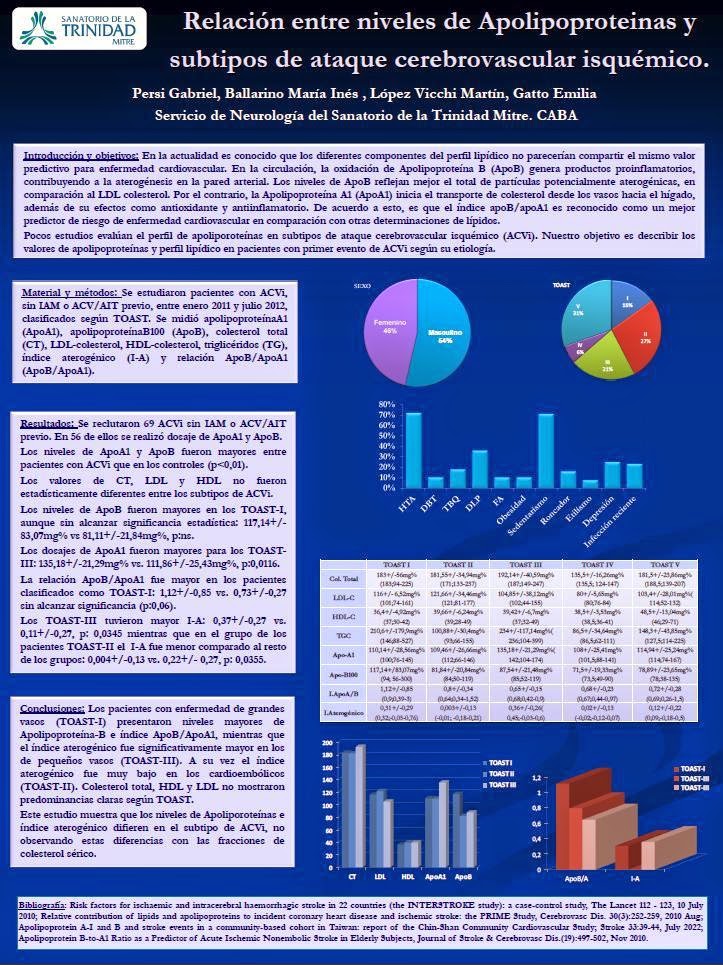
Relación entre niveles de Apolipoproteinas y subtipos de ataque cerebrovascular isquémico.
Autores 
Persi GG, Ballarino MI, López Vicchi MM, Gatto EM 

Pocos estudios evalúan el perfil de apoliporoteínas en subtipos de ataque cerebrovascular isquémico (ACVi). Nuestro objetivo es describir los valores de apolipoproteínas y perfil lipídico en pacientes con primer evento de ACVi según su etiología.

--------------
Se estudiaron pacientes con ACVi, sin IAM o ACV/AIT previo, entre enero 2011 y julio 2012, clasificados según TOAST. Se midió apolipoproteínaA1 (ApoA1), apolipoproteínaB100 (ApoB), colesterol total (CT), LDL-colesterol, HDL-colesterol, triglicéridos (TG), índice aterogénico (I-A) y relación ApoB/ApoA1 (I-BA). Los valores de Apolipoproteínas fueron comparados contra pacientes controles sin patología cerebral, coronaria o vascular periférica. 

-----------------
De 69 ACVi sin IAM o ACV/AIT previo, se midieron ApoA1 y ApoB en 56. Los niveles de ApoA1 y ApoB fueron mayores en ACVi que en controles (p<0,01). 
El CT, LDL y HDL no fueron estadísticamente diferentes entre los subtipos de ACVi.
ApoB fue mayor en los TOAST-I, aunque sin alcanzar significancia: 117,14+/-83,08mg% contra 81,11+/-21,84mg%, p:ns.
ApoA1 fue mayor para los TOAST-III: 135,18+/-21,30mg% vs. 111,86+/-25,43mg%, p:0.0116. El índice ApoB/ApoA1 fue mayor en los TOAST-I: 1,12+/-0,85 vs. 0,73+/-0,27 sin alcanzar significancia (p:0,06).
Los TOAST-III tuvieron mayor I-AI: 0,37+/-0,27 vs. 0,11+/-0,27, p: 0.0345. Mientras que los TOAST-II presentaron I-A menores que el resto de los grupos. 0,004+/-0,13 vs. 0,22+/- 0,27, p: 0,0355.

---------------
En conclusión, los pacientes con enfermedad de grandes vasos (TOAST-I) presentaron niveles mayores de Apolipoproteína-B e índice ApoB/ApoA1, mientras que el índice aterogénico fue significativamente mayor en los de pequeños vasos (TOAST-III). A su vez el índice aterogénico fue muy bajo en los cardioembólicos (TOAST-II). Colesterol total, HDL y LDL, no mostraron predominancias claras para el TOAST.
Este estudio muestra que los niveles de apoliporoteínas e índice aterogénico difieren en el subtipo de ACVi, no observando estas diferencias con las fracciones de colesterol sérico


martes, 18 de noviembre de 2014

AAN 2012

Comparison of Risk Factors between First Ischemic Stroke and Myocardial Infarction at a Medical Center in Buenos Aires City, Argentina


Emilia Gatto, Ines Ballarino, Gabriel Persi, Sabrina Antongiovanni, Matías Failo and Virginia Parisi

Sanatorio de la Trinidad Mitre Buenos Aires Argentina


Objective: to analyze the risk factors (RF) distribution in first stroke or MI in a population with similar socioeconomic characteristics and access to health resources.


Background Ischemic Stroke (IS) and Myocardial Infarction (MI) share their main classical risk factors (RF). These conditions, however, could predispose in a different manner to suffer either IS or MI.
Design/Methods: We prospectively collected data from patients diagnosed with first IS or MI, who were admitted at our center in Buenos Aires, Argentina, from January to June 2011. We analyzed demographic characteristics, classical risk factors such as diabetes, hypertension and dyslipidemia, smoking, and usual and previous medication and event features. Descriptive statistics and nonparametric tests were used.
Results: In this period of time 48 patients with IS and 17 with IM were evaluated in our institution. Sixteen patients with their first MI and 25 with a first IS were included for the analysis. Ischemic stroke patients were slightly older than MI patients (median 60 vs. 73 years, p: 0.0382). A male/female ratio of 7/1 was observed in the MI group and 1.5/1 in IS patients. This difference in sex distribution did not reach statistical significance. Current smoking/ever smoking was more prevalent in the MI group (32% vs 87.5%, P: 0.001), and dyslipidemia was slightly more frequent in MI patients (24 vs 62.5%, p: 0.022). We did not find differences in the prevalence of diabetes, hypertension and previous or usual medication (aspirin, statins, ACEI and ARA) between groups.
Conclusions: As described in the literature, classical RF distribution was different between first Ischemic Stroke and first Myocardial Infarction. Based on these results, a second study with a larger number of patients is currently underway in search of non-conventional RF in both groups of patients.
Neurology April 25, 2012; 78(Meeting Abstracts 1): P05.222